


by Sarada Lahangir
In a world where climate action is often driven by loud voices and grand gestures, some changemakers are working quietly yet leaving an indelible mark. Sakuntala Pratihary Nanda, 50, from Odisha, is one among such changemakers.
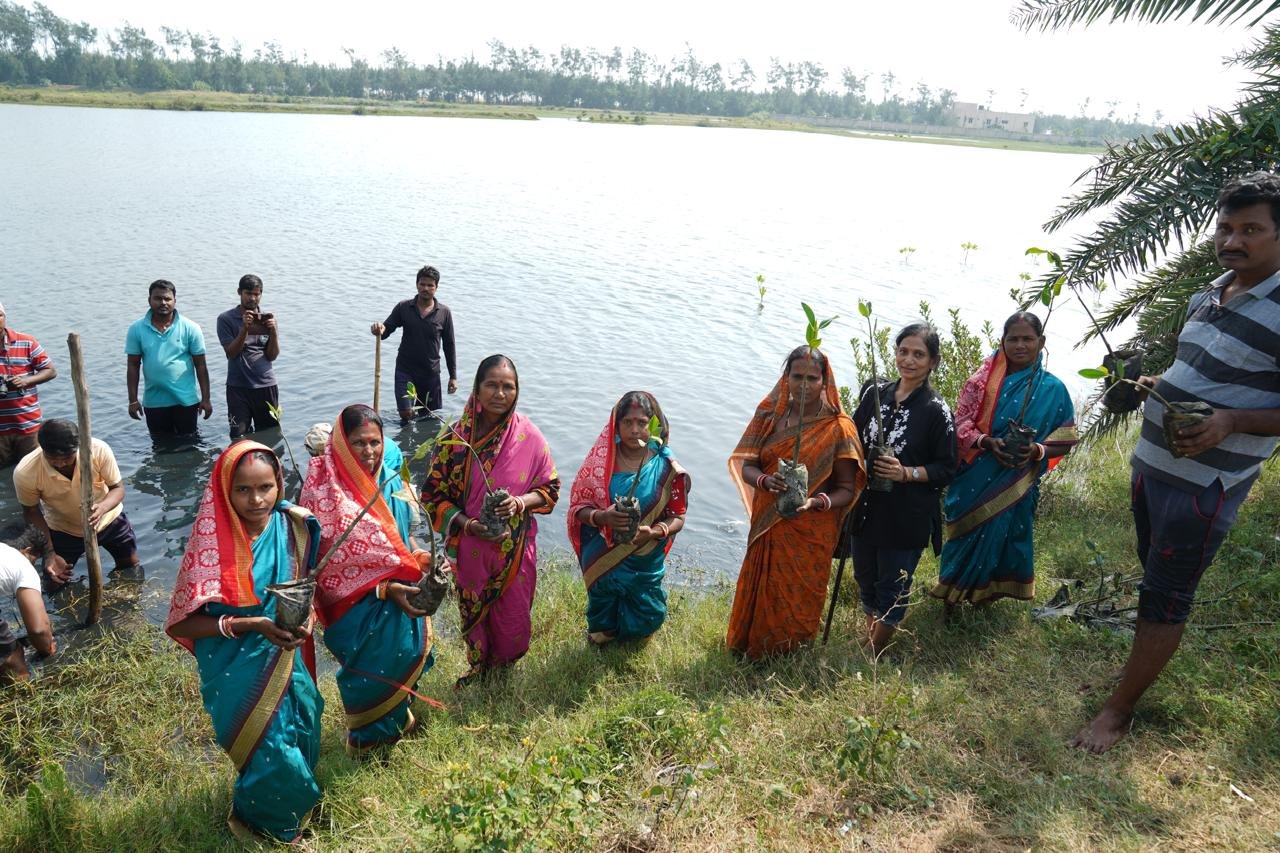
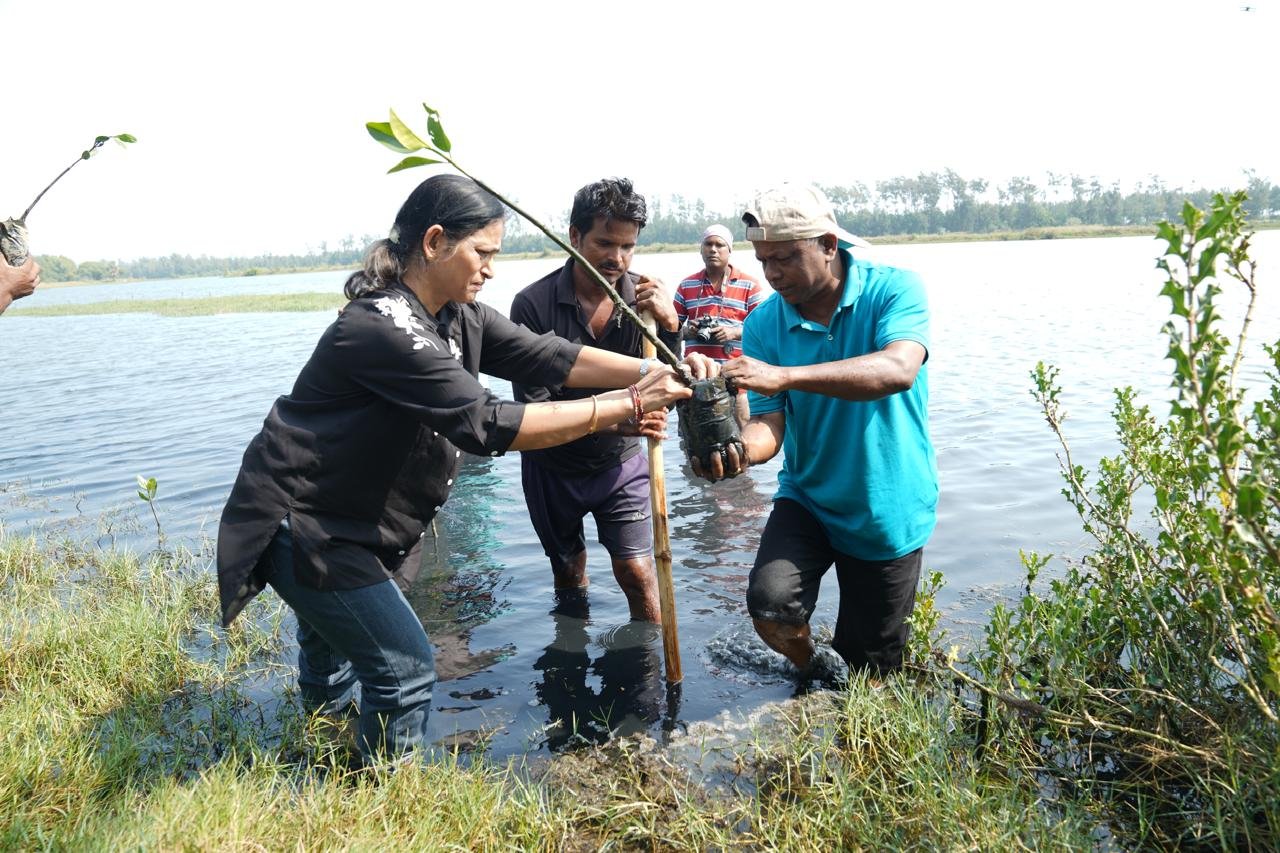
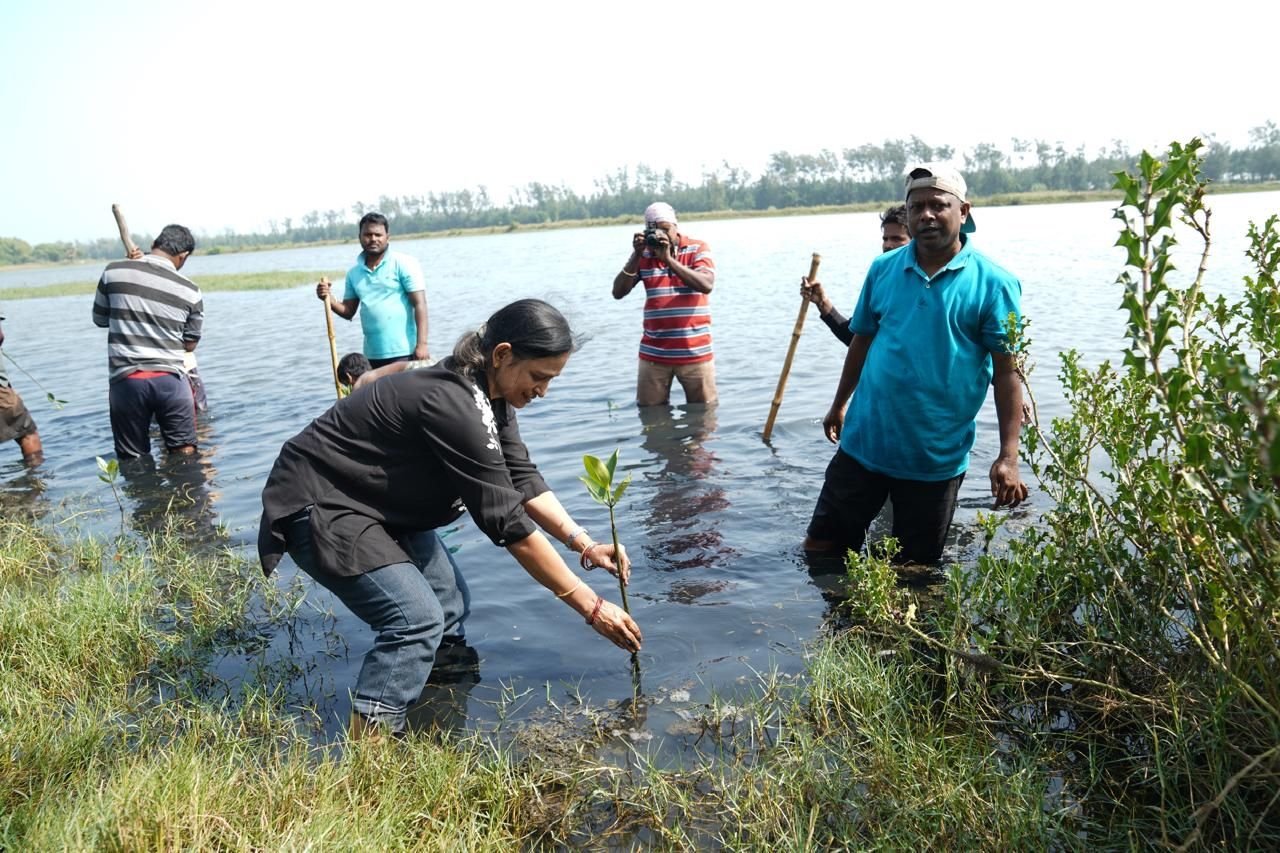
On the eastern coastline of India, where the mighty Bay of Bengal meets the fragile coastal ecosystem of Odisha, which has a breathtaking beauty but is also considered a place of extreme peril, Sakuntala stands as an example of resilience. Standing quietly in the mud along with her team and planting seeds, Sakuntala is on a mission to turn around the state’s seaside landscape, one root at a time. An academic-turned-activist, she is on a crusade to protect mangrove forests-the natural shield that stands between a village and a catastrophe.
A legacy of learning
Born in a traditional servitor family in Puri district, Sakuntala grew up in a community where women are meant to take care of the family. There was no inspiration, and women in her community didn’t dare think beyond their household chores for their future.
However, Sakuntala’s family was fortunately a progressive one. Her family placed a high value on education. Her father, Trayelokyanath Pratihary, ensured that all his children, including Sakuntala and her three siblings, got a strong educational foundation. So Sakuntala pursued her master’s and M.Phil. in economics and joined as a college professor. She has always had a passion for research and acquiring new knowledge.
She learned about climate change, a field she had never studied before, while teaching development economics in 2007. This made her interested in climate change, so she decided to learn more about it. As a result, she pursued a Ph.D. in climate change, poverty, and human development. She has been studying different aspects of climate change and biodiversity for the past few years, especially along the 480-kilometer coastline of Odisha, which is very prone to disasters caused by climate change.
The Question That Changed Everything
The transition from teacher to activist happened in 2007. While teaching development economics, Sakuntala came across a few paragraphs on climate change. It felt like a spark in a dark room. She began to read more. She looked at the data on rising sea levels and the increasing frequency of super-cyclones.
One evening, a thought struck her with the force of a tidal wave. She imagined her future grandchildren. She imagined them looking at a degraded world and asking, “Grandmother, you knew this was happening. What did you do about it?”
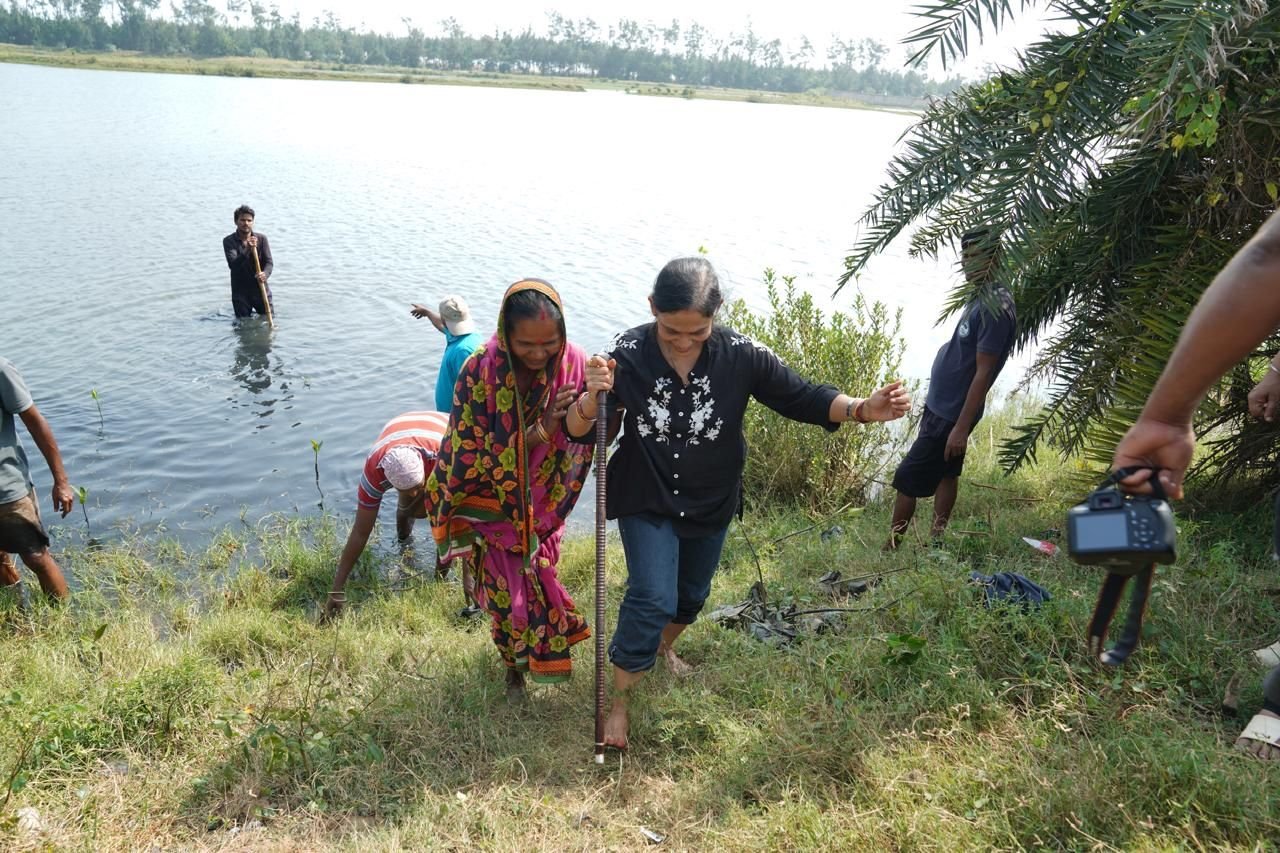
That moment of introspection was her “call to action.” She realized that writing papers was not enough. The coastline didn’t need more theories; it needed roots in the ground. In 2020, she completed her Ph.D. and started the Centre for Research and Community Action (CeRCA) to further environmental conservation efforts.
Reality Check through Coastal survey
Sakuntala wasn’t alone in her resolution. Her husband, Ambika Nanda, a veteran development professional, supported her. Together, they formed a partnership of purpose. In 2022, they decided to see the reality for themselves. They embarked on an exhausting survey of Odisha’s entire coastline.
They walked through villages where the sea had swallowed homes. They spoke to fishermen who could no longer find fish. They saw the barren patches where once there were thick forests. The survey made them realise that where mangroves flourished, the land survived. Where they were gone, the villages were vulnerable.
Mangroves: A Natural Shield
It’s difficult to wrap your head around just how much these forests do for us until you see them in action. In Odisha’s Kendrapada district, the memory of the 1971 cyclone still haunts the older generations—a tragedy that claimed thousands of lives and swallowed entire villages. That disaster was a turning point, leading to the inception of the Bhitarkanika conservation efforts in 1975. Since then, the mangroves have served as a resilient and ever-evolving sanctuary.
These trees are nature’s ultimate shock absorbers. Their dense canopy and tangled, arching prop roots create a physical barrier that literally “defangs” a cyclone. They defang the wind, flatten the wave swell, and trap heavy debris that would otherwise act as battering rams against coastal homes. When the sea rolls back after a surge, these roots act like a safety net, often catching valuables and household items before they are swept into the deep. For the people living behind this green wall, the difference is everything.
As Bishwanath Mandal, 52, from Gupti, Kendrapada, puts it, “I was worried when the cyclone was approaching, but I had faith in the mangroves. When we returned the next morning, everything was intact—our homes, our belongings. We owe our safety to the mangroves.”
Community-Led Mangrove Conservation
Sakuntala knew she couldn’t plant a forest alone; she needed the community. Through her organization, CeRCA, she partnered with groups like APOWA and the Satvik Soul Foundation to mobilize at the grassroots. The hurdles were often psychological, as many villagers viewed mangroves as “useless” bushes blocking shrimp farming. Sakuntala spent months in dialogue under village trees, explaining the economics of disaster. “We sat with the community and helped them understand how mangroves can save their lives and livelihoods. They already knew its importance—we just motivated them to take action before it’s too late. We called it “Mangroves for Resilience,” she explains. This effort bore fruit at the Jatadhar River mouth, where an initial 10,000 mangrove saplings have now grown into a forest and protected about 1.5 lakh mangrove trees. “As of now, we have planted about 80 thousand saplings,” Sakuntala says proudly.
Women Leading the Way in Climate Action
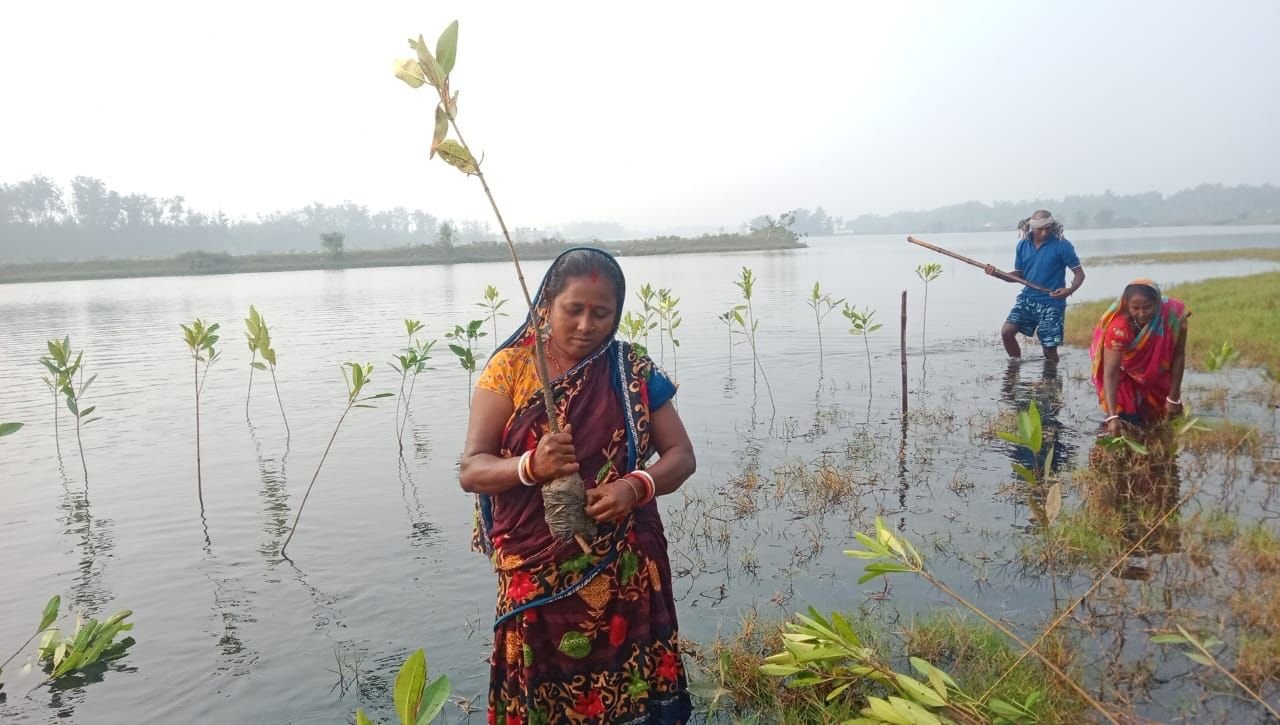
The true breakthrough came when Sakuntala engaged the women of the coast. Often the most vulnerable to climate disasters, these women were the most resilient, with nearly 2,000 joining the movement to restore the ecosystem. In villages like Siali and Gartadang, they became the “Mangrove Mothers,” building nurseries and wading into knee-deep mud to plant. Sundari Mondal, 47, has spent 15 years nurturing over 200,000 saplings. When Cyclone Dana struck, the trees she planted stood as strong sentinels. “We get fish and crabs from the swamp,” Sundari says. “But more than that, we get security. The mangroves are our guardians.”
The State of the Shield: India and Odisha
Despite their vital role in protecting coastlines from erosion and extreme weather, mangroves make up only a small portion of the world’s forests. According to the Global Forest Resource Assessment 2020, mangroves span 14.79 million hectares globally, with Asia leading at 5.55 million hectares. According to the India State of Forest Report (ISFR) 2023, the area under mangroves has reduced to 4,991.68 square kilometres (0.15% of its total land area), reflecting a decline of 7.43 sq km over the past two years. Odisha contributing 258.98 sq. km (5.18%), ranking sixth among states. India’s mangrove cover grew by 17 sq. km from 2019 to 2021, with Odisha leading at 8 sq. km, particularly in Kendrapara, Jagatsinghpur, and Balasore due to natural regeneration and plantation efforts.
Despite this progress, Odisha’s mangroves face threats from population growth, agriculture, and prawn farming. Conservation efforts continue, aiming to protect these ecosystems vital for both people and biodiversity.
Overcoming Resistance
Despite their benefits, mangrove forests are disappearing at an alarming rate. Wetlands, crucial for biodiversity and climate resilience, are experiencing faster degradation than any other ecosystem. These ecosystems are vanishing much faster than forests, threatening biodiversity, coastal protection, carbon storage, and vital ecosystem services, with warnings from organizations like the UN and IUCN indicating that over half of mangroves are at risk by 2050.
The path has been rocky until today. Industrial interests often see coastal land as prime real estate for factories or ports. They view mangroves as obstacles. Sakuntala always stood her ground against powerful voices.
Sometimes, even within the community, there are hurdles. Some fishermen feared that protected forests would mean restricted access. Sakuntala worked to bridge these gaps. She showed them that mangroves are actually “fish nurseries.” The roots provide safety for young fish and crabs. More mangroves mean more fish in the long run.
Government support has been a mixed bag. While policies for wetland protection exist, enforcement is often thin on the ground. Sakuntala acts as the bridge between high-level policy and muddy-boot reality.
A Vision for the Future
Every July 26, on International Mangrove Day, Sakuntala gathers her growing army of volunteers. They don’t just celebrate; they plant. For Sakuntala, every sapling is a promise kept to those hypothetical grandchildren she imagined years ago.
Her work has transformed more than just the landscape. It has transformed the social fabric of these villages. Women who were once confined to their homes are now environmental leaders. They are negotiators, planters, and protectors.
Sakuntala Pratihary Nanda always remains humble. She considers herself a student of the coast. She knows the climate crisis is a huge one, but she believes in the power of small, collective actions.
“Together, we will make a difference,” she often says. It isn’t just a slogan; it is a lived reality. Through her leadership, the “Green Shield” of Odisha is growing thicker every day. She is not just planting trees; she is planting hope in the very soil that the sea tries to take away.